


Datadog CLI for AI Agents

CLIs are eating MCPs. The industry is converging on the very same idea. MCPs for all their merit can be token hungry, slow, and unreliable for complex tool chaining. However, coding agents have become incredibly good at working with CLIs, and in fact they are far more comfortable working with CLI tools than MCP. With Composio's Universal CLI, your coding agents can talk to over 1000+ SaaS applications. With Datadog, agents can create downtime for nightly maintenance window, list all monitors tracking cpu usage, create synthetic api test for login endpoint, and more — all without worrying about authentication. This guide walks you through Composio Universal CLI and explains how you can connect it with coding agents like Claude Code, Codex, OpenCode, etc, for end-to-end Datadog automation.

Datadog logoDatadog
Oauth2Api Key

Datadog is a cloud monitoring and observability platform for applications and infrastructure. It helps teams detect issues and optimize performance by unifying metrics, logs, and traces.

42 Tools

Introduction

CLIs are eating MCPs. The industry is converging on the very same idea. MCPs for all their merit can be token hungry, slow, and unreliable for complex tool chaining. However, coding agents have become incredibly good at working with CLIs, and in fact they are far more comfortable working with CLI tools than MCP.

With Composio's Universal CLI, your coding agents can talk to over 1000+ SaaS applications. With Datadog, agents can create downtime for nightly maintenance window, list all monitors tracking cpu usage, create synthetic api test for login endpoint, and more — all without worrying about authentication.

This guide walks you through Composio Universal CLI and explains how you can connect it with coding agents like Claude Code, Codex, OpenCode, etc, for end-to-end Datadog automation.

Also integrate Datadog with

What is Universal CLI and why use it?

The idea behind building the universal CLI is to give agents a single command interface to interact with all your external applications. Here's what you'll get with it:

  • Agent-friendly: Coding agents like Claude Code, Codex, and OpenCode can use CLI tools natively — no MCP setup required.
  • Authentication handled: Connect once via OAuth or API Key, and all CLI commands work with your credentials automatically.
  • Tool discovery: Search, inspect, and execute 20,000+ tools across 1000+ apps from one interface.
  • Trigger support: Use triggers to listen for events across your apps, powered by real-time webhooks or polling under the hood.
  • Type generation: Generate typed schemas for autocomplete and type safety in your projects.

Prerequisites

Install the Composio CLI, authenticate, and initialize your project:

bash
# Install the Composio CLI
curl -fsSL https://composio.dev/install | bash

# Authenticate with Composio
composio login

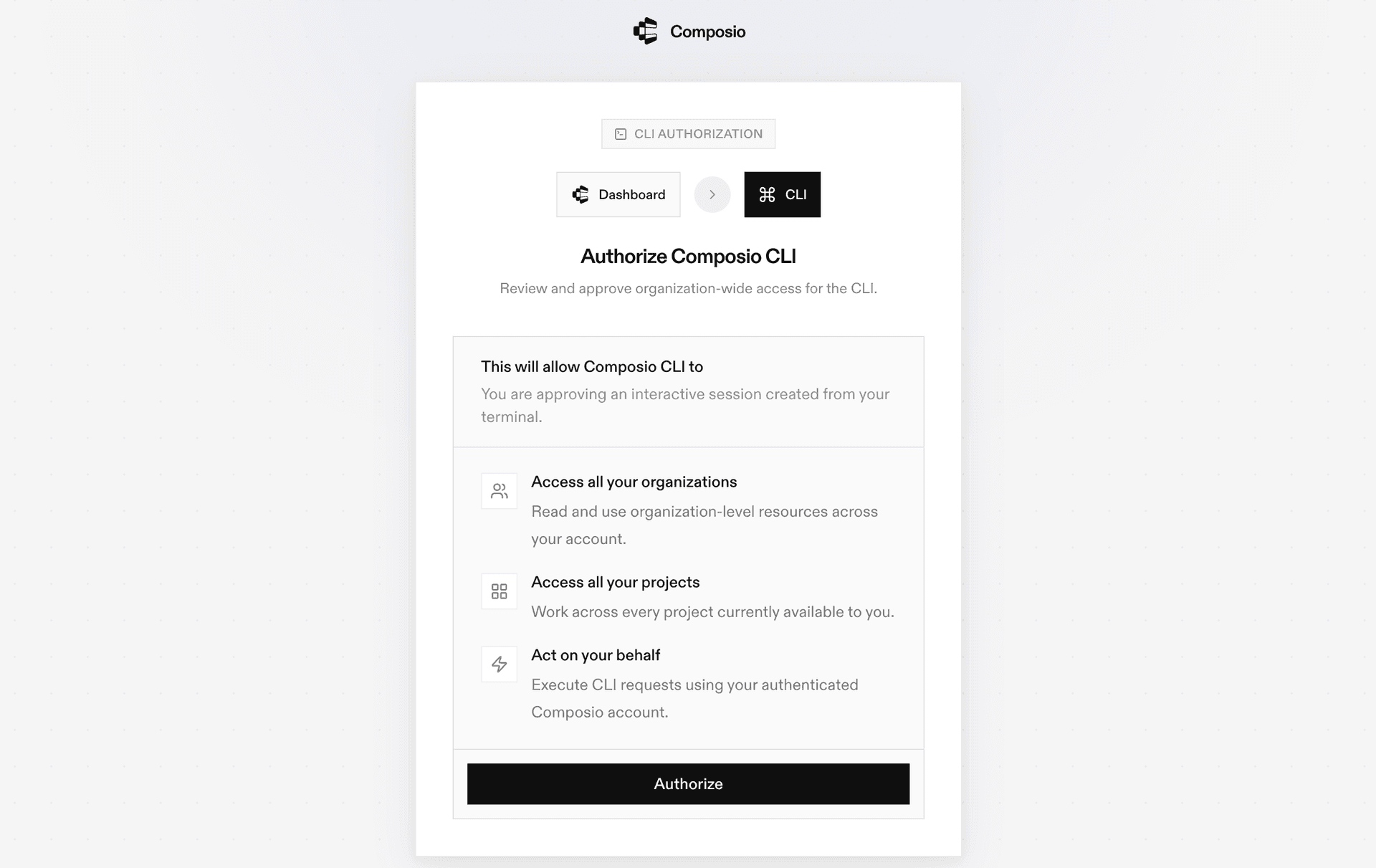
During login you'll be redirected to sign in page, finish the complete flow and you're all set.

Composio CLI authentication flow

Connecting Datadog to Coding Agents via Universal CLI

Once it is installed, it's essentially done. Claude Code, Codex, OpenCode, OpenClaw, or any other agent will be able to access the CLI. A few steps to give agents access to your apps.

  1. Launch your Coding Agent — Claude Code, Codex, OpenCode, anything you prefer.
  2. Prompt it to "Authenticate with Datadog"
  3. Complete the authentication and authorization flow and your Datadog integration is all set.
  4. Start asking anything you want.

Universal CLI Commands for Datadog

You can also manually execute CLI commands to interact with your Datadog.

Connect your Datadog account

Link your Datadog account and verify the connection:

bash
# Connect your Datadog account (opens OAuth flow)
composio connected-accounts link datadog

# Verify the connection
composio connected-accounts list --toolkits datadog

Discover Datadog tools

Search and inspect available Datadog tools:

bash
# List all available Datadog tools
composio tools list --toolkit datadog

# Search for Datadog tools by action
composio tools search "datadog"

# Inspect a tool's input schema
composio tools info DATADOG_CREATE_DASHBOARD

Common Datadog Actions

Create DashboardCreate a dashboard in datadog

bash
composio tools execute DATADOG_CREATE_DASHBOARD \
  --title "<string>" \
  --widgets "<array>"

Create downtimeCreates a new downtime in datadog to suppress alerts during maintenance windows or planned outages

bash
composio tools execute DATADOG_CREATE_DOWNTIME \
  --scope '["host:web-server-01"]'

Create eventCreates a new event in datadog

bash
composio tools execute DATADOG_CREATE_EVENT \
  --text "Successfully deployed version 1.2.3 to production" \
  --title "Deployment completed"

Create monitorCreates a new datadog monitor to track metrics, logs, or other data sources with configurable alerting thresholds and notifications

bash
composio tools execute DATADOG_CREATE_MONITOR \
  --name "High CPU Usage" \
  --type "metric alert" \
  --query "avg(last_5m):avg:system.cpu.user{*} > 80"

Generate Type Definitions

Generate typed schemas for Datadog tools to get autocomplete and type safety in your project:

bash
# Auto-detect language
composio generate --toolkits datadog

# TypeScript
composio ts generate --toolkits datadog

# Python
composio py generate --toolkits datadog

Tips & Tricks

  • Always inspect a tool's input schema before executing: composio tools info <TOOL_NAME>
  • Pipe output with jq for better readability: composio tools execute TOOL_NAME -d '{}' | jq
  • Set COMPOSIO_API_KEY as an environment variable for CI/CD pipelines
  • Use composio dev logs tools to inspect execution logs and debug issues

Next Steps

  • Try asking your coding agent to perform various Datadog operations
  • Explore cross-app workflows by connecting more toolkits
  • Set up triggers for real-time automation
  • Use composio generate for typed schemas in your projects
TOOLS

Supported Tools

Every Datadog action and event your agent gets out of the box.

Create Dashboard

Create a dashboard in Datadog.

Create downtime

Creates a new downtime in Datadog to suppress alerts during maintenance windows or planned outages.

Create event

Creates a new event in Datadog.

Create monitor

Creates a new Datadog monitor to track metrics, logs, or other data sources with configurable alerting thresholds and notifications.

Create SLO

Create a Service Level Objective (SLO) in Datadog.

Create Synthetic API Test

Create a synthetic API test in Datadog.

Create Webhook

Create a webhook in Datadog.

Delete Dashboard

Delete a dashboard in Datadog.

Delete monitor

Deletes a Datadog monitor permanently.

Get Dashboard

Get a specific dashboard from Datadog.

Get monitor

Retrieves detailed information about a specific Datadog monitor, including its current state, configuration, and any active downtimes.

Get Service Dependencies

Get service dependency mapping from Datadog APM.

Get Synthetics Locations

Tool to retrieve all available public and private locations for Synthetic tests in Datadog.

Get host tags

Retrieves all tags associated with a specific host in Datadog.

Get usage summary

Retrieves usage summary information from Datadog including API calls, hosts, containers, and other billable usage metrics.

List All Tags

List all tags from Datadog.

List API Keys

List API keys in Datadog.

List APM Services

List APM services from Datadog.

List AWS Integration

List AWS integrations in Datadog.

List dashboards

Lists all Datadog dashboards with basic information.

List events

Lists events from Datadog within a specified time range.

List hosts

Lists all hosts in your Datadog infrastructure with detailed information including metrics, tags, and status.

List Incidents

List incidents from Datadog.

List Log Indexes

Tool to retrieve a list of all log indexes configured in Datadog, including their names and configurations.

List active metrics

Discover metric names by listing actively reporting metrics since a given timestamp.

List monitors

Get all monitor details.

List Roles

List roles from Datadog organization.

List service checks

Lists service checks from Datadog.

List SLOs

List Service Level Objectives (SLOs) from Datadog.

List Synthetics Tests

List Synthetics tests from Datadog.

List Users

List users from Datadog organization.

List Webhooks

List webhooks from Datadog.

Mute Monitor

Mute a monitor in Datadog.

Query metrics

Queries Datadog metrics and returns time series data.

Search logs

Searches Datadog logs with advanced filtering capabilities.

Search Spans Analytics

Search and analyze span data with aggregations in Datadog.

Search Traces

Search for traces in Datadog APM.

Submit metrics

Submits custom metrics to Datadog.

Unmute Monitor

Unmute a monitor in Datadog.

Update Dashboard

Update a dashboard in Datadog.

Update host tags

Updates tags for a specific host in Datadog.

Update monitor

Updates an existing Datadog monitor with new configuration, thresholds, or notification settings.

FAQ

Frequently asked questions

The Composio Universal CLI is a single command-line interface that lets coding agents and developers interact with 1000+ SaaS applications. It handles authentication, tool discovery, action execution, and trigger setup — all from the terminal, without needing to configure MCP servers.

Any coding agent that can run shell commands works with the Composio CLI — including Claude Code, Codex, OpenCode, OpenClaw, and others. Once the CLI is installed, agents automatically discover and use the composio commands to interact with Datadog and other connected apps.

MCP servers require configuration and can be token-heavy for complex workflows. The CLI gives agents a direct, lightweight interface — no server setup needed. Agents simply call composio commands like any other shell tool. It's faster to set up, more reliable for multi-step tool chaining, and works natively with how coding agents already operate.

All sensitive data such as tokens, keys, and configuration is fully encrypted at rest and in transit. Composio is SOC 2 Type 2 compliant and follows strict security practices so your Datadog data and credentials are handled as safely as possible. You can also bring your own OAuth credentials for full control.

Start with Datadog.It takes 30 seconds.

Managed auth, hosted MCP servers, and every Datadog tool your agent needs.Free to start.

Start building