How to integrate Canva MCP with OpenCode

How to integrate Canva MCP with OpenCode This guide explains how to connect Canva MCP to OpenCode using Composio Connect, which simplifies OAuth, API changes, and reliability concerns. There are two ways to set this up: Via Composio Connect MCP Via the Composio CLI

Canva logoCanva
Oauth2

Canva is a drag-and-drop design suite for creating professional graphics, presentations, and marketing materials. It makes it easy for anyone to design with beautiful templates and a vast library of elements.

46 Tools

How to integrate Canva MCP with OpenCode

This guide explains how to connect Canva MCP to OpenCode using Composio Connect, which simplifies OAuth, API changes, and reliability concerns.

There are two ways to set this up:

Also integrate Canva with

Why use Composio?

Composio provides a single MCP server or CLI tool that exposes a set of meta-tools, allowing you to:

  • Connect to 1,000+ apps with on-demand tool loading, so you do not fill your LLM context window with unnecessary tool definitions.
  • Use programmatic tool calling through a remote Bash tool, letting LLMs write their own code to handle complex tool chaining. This reduces back-and-forth for frequent tool calls.
  • Handle large tool responses outside the LLM context to keep conversations lean.

Connect Canva with OpenCode

Option 1: Using Composio CLI

1. Install Composio CLI

Install the Composio CLI, authenticate, and initialize your project:

bash
# Install the Composio CLI
curl -fsSL https://composio.dev/install | bash

# Authenticate with Composio
composio login

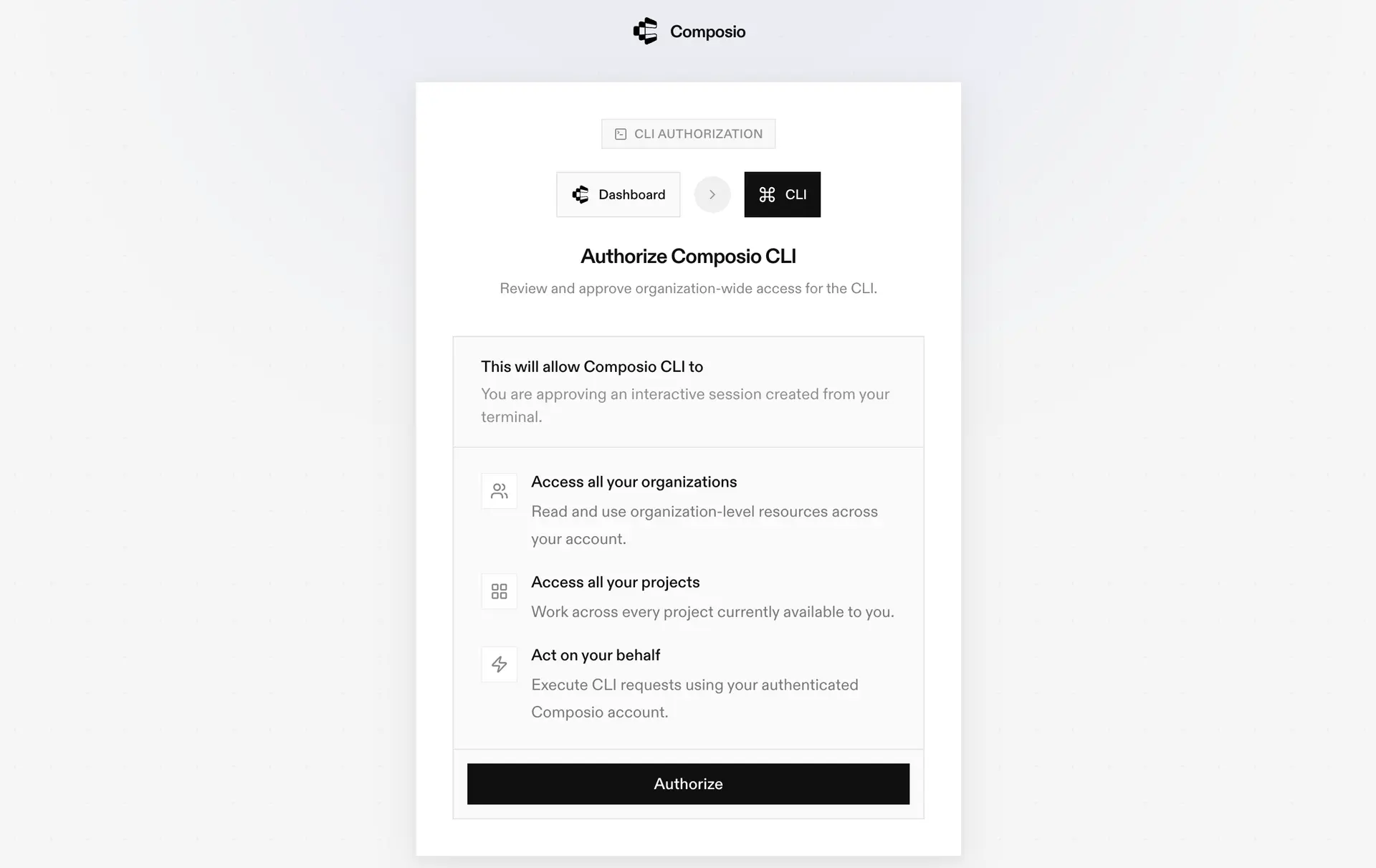
During login, you will be redirected to the sign-in page. Finish the flow and you are all set.

Composio CLI authorization screen

2. Authorize Canva

Once the CLI is installed, it is essentially done. Give OpenCode access to your apps with these steps:

  1. Launch OpenCode.
  2. Prompt it to "Authenticate with Canva Composio".
  3. Complete the authentication and authorization flow, and your Canva integration is all set.
  4. Start asking anything you want.

Option 2: Using Composio MCP

You can also connect Canva to OpenCode by adding Composio as an MCP server through the OpenCode CLI.

1. Add the Composio MCP server

bash
opencode mcp add

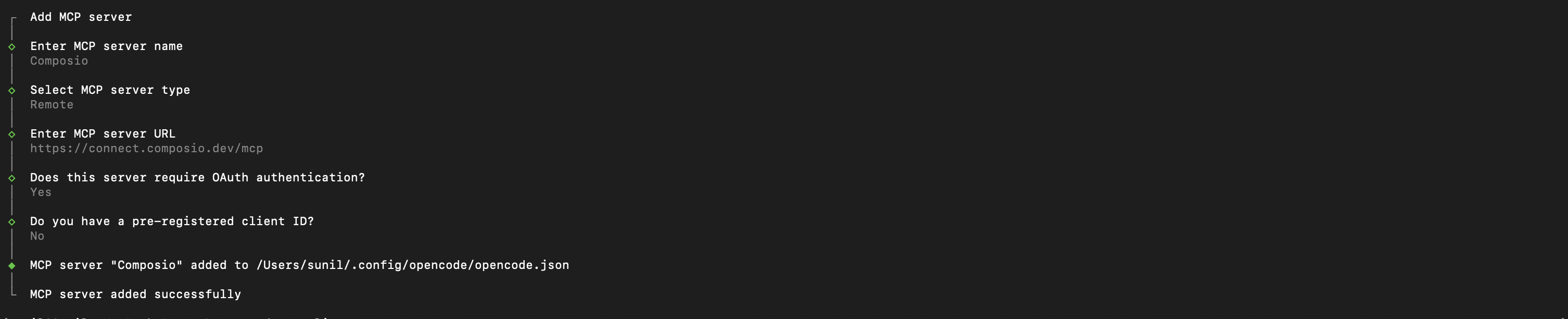
This launches an interactive prompt.

2. Fill in the fields

FieldValue
Namecomposio
Typeremote
URLhttps://connect.composio.dev/mcp
Require OAuthYes
Have client IDNo
OpenCode MCP server interactive prompt for Composio

Alternatively, you can skip the interactive prompt and paste the configuration directly into your OpenCode config file.

Open your global OpenCode config:

bash
open ~/.config/opencode/opencode.json

Add this under the mcp key and save the file.

bash
{
  "mcp": {
    "composio": {
      "type": "remote",
      "url": "https://connect.composio.dev/mcp",
      "enabled": true
    }
  }
}

3. Authenticate

Authenticate the Composio MCP server you just added:

bash
opencode mcp auth composio

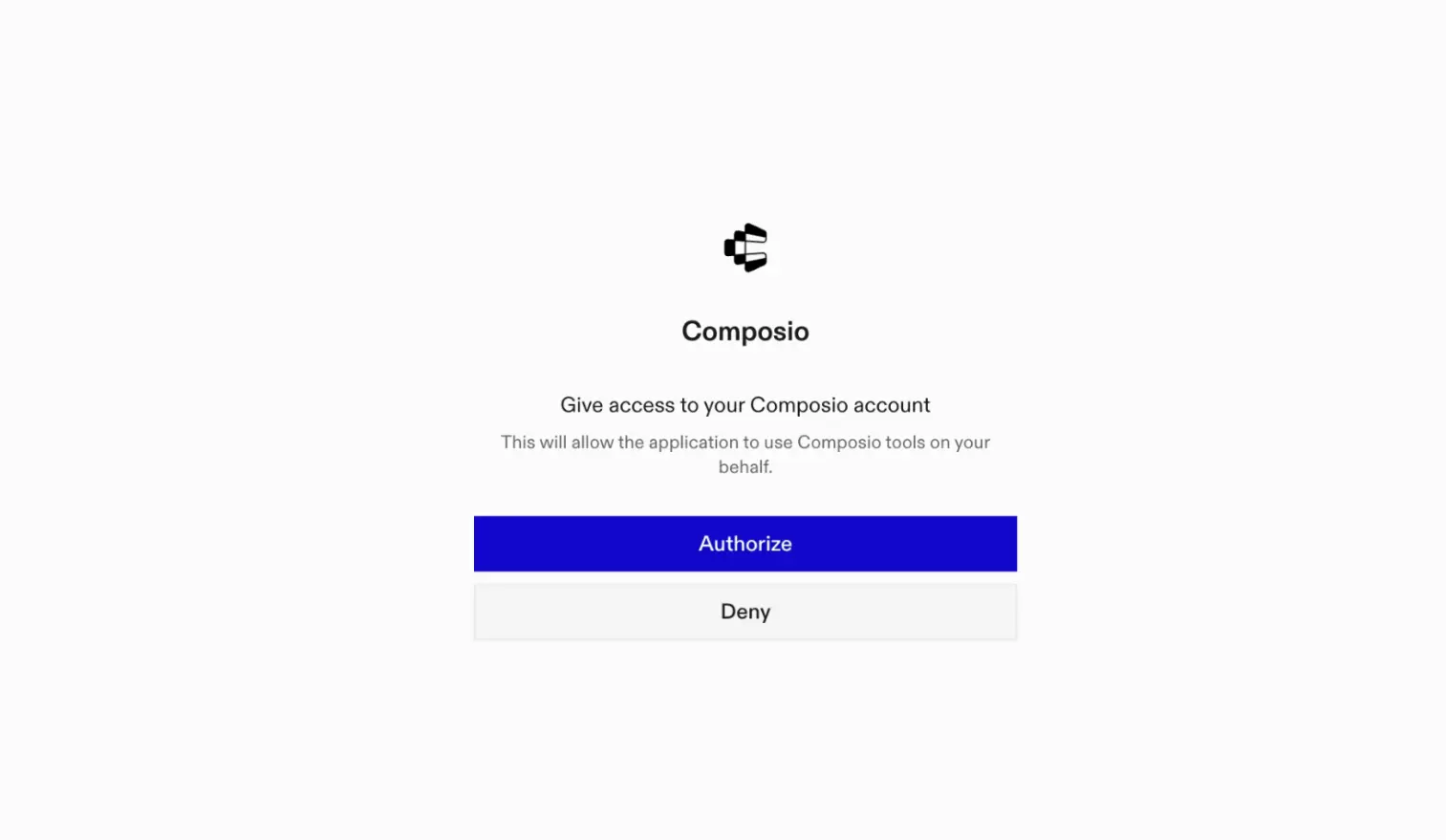
This opens a browser session. Authorize Composio and you are done.

Composio browser authorization for OpenCode MCP

4. Verify installation

bash
opencode mcp list

5. Connect Canva with OpenCode

Now, in the chat, ask the agent to connect to Canva or give it any Canva-related task.

For example, ask it to:

  • "Create a new Instagram post design"
  • "List your brand templates for social use"
  • "Start a folder for this project’s assets"

It will prompt you to authenticate and authorize access to Canva.

That is it. Composio tools are now available in OpenCode, and your Canva account is ready to use.

Way Forward

Now that Canva is connected, extend your setup by connecting the other apps you already use every day, so your agent can run true cross-app workflows end to end.

  • Connect Calendar to turn threads into scheduled meetings automatically.
  • Connect Slack or Teams to post summaries, approvals, and alerts where your team works.
  • Connect Notion, Linear, Jira, or Asana to convert requests into tickets, tasks, and docs.
  • Connect Drive, Dropbox, or OneDrive to fetch, file, and share attachments without manual steps.

Start with one workflow you do repeatedly, then keep adding apps as you find new handoffs. With everything behind a single MCP endpoint, your agent can coordinate multiple tools safely and reliably in one conversation.

TOOLS

Supported Tools

Every Canva action and event your agent gets out of the box.

Access user specific brand templates list

Lists brand templates available to the user (Canva Enterprise only).

Create Asset Upload Job

Uploads an asset file to the user's Canva content library.

Create comment reply in design

This preview API allows replying to comments within a design on Canva, with a limit of 100 replies per comment.

Create design comment in preview api

Creates a new comment thread on a Canva design.

Create Design Import Job

Imports an external file as a new Canva design.

Create Design Resize Job

Creates a resized copy of an existing design (Canva Pro/Enterprise only).

Create URL Asset Upload Job

Tool to create an asynchronous Canva asset import job from a public URL.

Delete asset by id

You can delete an asset by specifying its `assetId`.

Exchange oauth 2 0 access or refresh token

The OAuth 2.

Fetch asset upload job status

Polls for asset upload job completion status.

Fetch canva connect signing public keys

The API for verifying Canva webhooks, 'connect/keys,' is in preview, meaning unstable, not for public integrations, and provides a rotating JWK for signature verification to prevent replay attacks.

Fetch current user details

Returns the User ID, Team ID, and display name of the user account associated with the provided access token.

Fetch design metadata and access information

Gets the metadata for a design.

Get design comment thread replies

Retrieves a list of replies for a comment or suggestion thread on a design.

Get specific design comment reply

Retrieves a specific reply to a comment or suggestion thread on a design.

Get design export job result

Polls for design export job completion status.

Get designs designid comments threadid

Retrieves metadata for a comment or suggestion thread on a design.

Get design export formats

Lists available file formats for exporting a design.

Get URL asset upload job status

Tool to retrieve the status and result of a URL-based asset upload job.

Get URL import job status

Polls for URL import job completion status.

Get user capabilities

Lists the API capabilities for the user account associated with the provided access token.

Initiate canva design autofill job

Upcoming brand template ID updates require migration within 6 months.

List design pages with pagination

Preview API for Canva: subject to unannounced changes and not for public integrations.

List folder items by type with sorting

Lists the items in a folder, including each item's `type`.

List User Designs

Provides a summary of Canva user designs, includes search filtering, and allows showing both self-created and shared designs with sorting options.

Move item to specified folder

Transfers an item to a different folder by specifying both the destination folder's ID and the item's ID.

Create new Canva design

Creates a new Canva design with preset type or custom dimensions.

Post designs designid comments

Creates a comment thread on a Canva design.

Create reply to comment thread

Tool to create a reply to a comment or suggestion thread on a Canva design.

Start design export job

Starts a new asynchronous job to export a Canva design file.

Create folder

Tool to create a folder in Canva.

Create URL Import Job

Tool to start an asynchronous job to import an external file from a URL as a new design in Canva.

Remove folder and move contents to trash

Deletes a folder by moving the user's content to Trash and reassigning other users' content to their top-level projects.

Retrieve app public key set

Returns the Json Web Key Set (public keys) of an app.

Retrieve asset metadata by id

You can retrieve the metadata of an asset by specifying its `assetId`.

Retrieve brand template dataset definition

Canva's brand template IDs will change later this year, including a 6-month integration migration.

Retrieve canva enterprise brand template metadata

Upcoming update will change brand template IDs; integrations must migrate within 6 months.

Retrieve design autofill job status

API users with Canva Enterprise membership can retrieve design autofill job results, potentially requiring multiple requests until a `success` or `failed` status is received.

Retrieve design import job status

Polls for design import job completion status.

Retrieve Design Resize Job Status

Retrieves the status and results of a design resize job.

Retrieve folder details by id

Gets the name and other details of a folder using a folder's `folderID`.

Retrieveuserprofiledata

Currently, this returns the display name of the user account associated with the provided access token.

Revoke oauth tokens

Revoke a refresh token to end its lineage and user consent, requiring re-authentication.

Update asset s name and tags by id

You can update the name and tags of an asset by specifying its `assetId`.

Update folder details by id

Updates a folder's details using its `folderID`.

Validate oauth token properties

Check an access token's validity and properties via introspection, requiring authentication.

FAQ

Frequently asked questions

With a standalone Canva MCP server, the agents and LLMs can only access a fixed set of Canva tools tied to that server. However, with the Composio Tool Router, agents can dynamically load tools from Canva and many other apps based on the task at hand, all through a single MCP endpoint.

Yes, you can. OpenCode fully supports MCP integration. You get structured tool calling, message history handling, and model orchestration while Tool Router takes care of discovering and serving the right Canva tools.

Yes, absolutely. You can configure which Canva scopes and actions are allowed when connecting your account to Composio. You can also bring your own OAuth credentials or API configuration so you keep full control over what the agent can do.

All sensitive data such as tokens, keys, and configuration is fully encrypted at rest and in transit. Composio is SOC 2 Type 2 compliant and follows strict security practices so your Canva data and credentials are handled as safely as possible.

Start with Canva.It takes 30 seconds.

Managed auth, hosted MCP servers, and every Canva tool your agent needs.Free to start.

Start building